
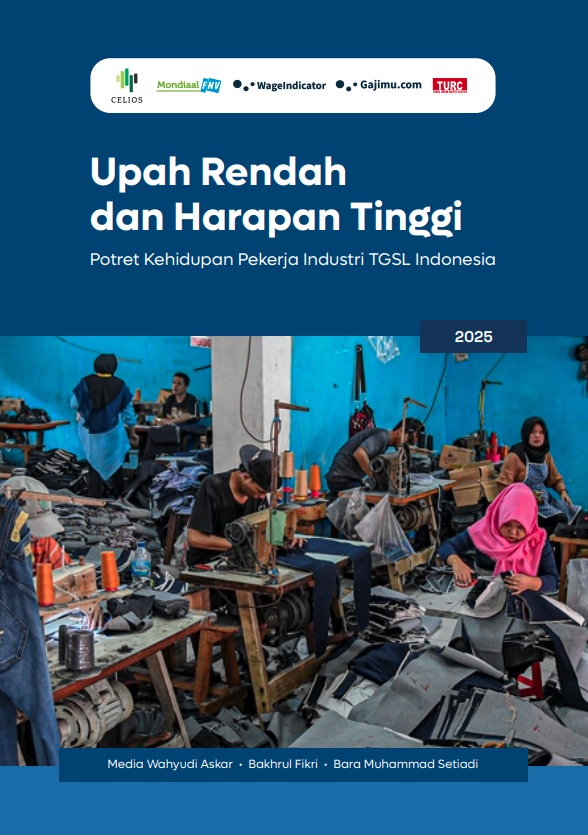
The study finds that 15% of companies fail to provide written contracts, depriving workers of legal recognition and protection. Over half (57%) of employees are hired on short-term contracts lasting less than 12 months, while 14% are forced to work more than 54 hours per week, in some cases up to 58 hours. These unstable employment conditions prevent workers from accessing fundamental rights such as health insurance and pension benefits. Although social security compliance improved until 2022, it has since declined sharply particularly in pension coverage, which dropped by 15%. Without serious law enforcement, only 58.8% of companies are projected to pay old-age security benefits by 2030. We concludes that post–Omnibus Law (UU Ciptaker) deregulation has intensified job precarity, stagnated real wages, and weakened workers’ bargaining positions, widening inequality across the labor market.
The report also highlights the gender dimension of labor vulnerability. Female workers are 4% more likely than men to earn below the minimum wage, 19% more likely to be denied severance pay, and 8% continue to perform hazardous work during pregnancy. Furthermore, 45% of contract workers report being banned from striking, while 12% are prohibited from joining labor unions. We warn that if participatory labor reform is not undertaken through transparent dialogue involving trade unions, academics, business actors, and civil society, Indonesia risks deepening inequality and eroding fundamental labor rights in the TGSL industry.
Bibliography:
Askar, M. W., Fikri, B., & Setiadi, B. M. (2025). Low Wages, High Hopes: A Feasibility Study of the TGSL Industry (Upah Rendah, Harapan Tinggi: Studi Kelayakan Kerja Industri TGSL). Center of Economic and Law Studies (CELIOS).

CELIOS’ macroeconomic simulation shows that increasing Indonesia’s VAT from 11% to 12% in 2025 would shrink GDP by about IDR 65 trillion and lower household consumption by over IDR 40 trillion. The report highlights how higher consumption taxes disproportionately hurt the lower-middle class and Gen Z, who already face stagnating incomes and rising living costs. Inflation is expected to climb to 4.1%, while pre-emptive price hikes could further erode purchasing power.
The study suggests alternative revenue measures such as wealth and carbon taxes, anti-evasion enforcement in palm oil and digital sectors, and trimming wasteful state expenditures. CELIOS warns that without compensatory policies, the tax hike may exacerbate inequality, increase financial stress, and harm long-term economic stability. Instead, it calls for inclusive fiscal reform that boosts revenue without burdening vulnerable households.
Bibliography:
Huda, N., Askar, M. W., Yudhistira, B., Fikri, M. B., Darmawan, J., & Muhamad, G. D. (2024). VAT 12%: A Heavy Blow to Gen Z and the Lower Middle Class Wallets. Center of Economic and Law Studies (CELIOS).

This report analyzes the environmental and climate implications of Indonesia’s Merauke Food Estate project, which involves clearing vast forest areas for agricultural expansion. CELIOS estimates that deforestation from the project could release up to 0.86 gigatons of CO₂ roughly equivalent to Indonesia’s total annual emissions, potentially delaying the nation’s net-zero target by up to a decade. The report warns that such projects contradict the government’s climate commitments and endanger global climate goals.
The authors propose alternative development pathways that prioritize sustainable land use, community-based agriculture, and forest preservation. They argue that Indonesia’s competitive advantage lies in being a global carbon sink rather than an emitter. The report concludes that halting large-scale deforestation is not only environmentally essential but also economically rational for long-term national resilience.
Bibliography:
Askar, M. W. (2024, December). Vanishing Forests and Rising Emissions: How the Merauke Food Estate Speeds Up the Climate Crisis. Center of Economic and Law Studies (CELIOS).

This demand-side study reveals the structural and digital barriers faced by Indonesian women e-commerce entrepreneurs. Despite representing 64% of MSMEs, women earn 22% less on average than men. Challenges include low access to finance, limited mentorship, and digital literacy gaps. Through survey analysis, the report finds that only 44% of women-led online businesses survive beyond three years, emphasizing the fragility of gendered digital participation.
The report calls for gender-responsive design in financial products and platforms. It advocates inclusive data use, mentorship networks, and co-created digital finance tools. We conclude that closing the gender digital finance gap could add USD 11 billion annually to Indonesia’s economy.
Bibliography:
Salyanty, A. (2023). Building Digital Finance Solutions for Women E-Commerce Entrepreneurs: A Demand-Side Exploration in Indonesia. Women’s World Banking.

This Women’s World Banking report explores how rural Indonesian women navigate exclusion from formal finance while maintaining complex informal financial systems. The study reveals persistent regional disparities, with many women in Eastern Indonesia still lacking access to banking and digital services. Factors such as mobility restrictions, weak infrastructure, and limited financial products suited to rural realities hinder inclusion more than digital illiteracy itself.
The report recommends collaborative solutions that combine local agents, gender-sensitive product design, and partnerships with fintech platforms. It calls for multi-level strategies, strengthening agent networks, providing training, and engaging women leaders as advocates, to close the rural gender gap in finance. Achieving full inclusion, it argues, will empower women as key economic actors and improve household resilience nationwide.
Bibliography:
Salyanty, A. (2024, April). Reaching Rural Women: Catalyzing Financial Inclusion at the Edge of Finance. Women’s World Banking.

This CELIOS report delivers a critical fiscal audit of the Joko Widodo administration’s legacy, identifying ten structural “fiscal holes” that will burden Indonesia’s future governments. These include massive subsidy inefficiencies, ballooning public debt, opaque state-owned enterprise (SOE) liabilities, and misaligned budget priorities that undermine long-term sustainability. According to the infographic on page 6, total fiscal exposure from these combined gaps reaches IDR 1,850 trillion, equivalent to 45% of the 2024 state budget. The report further warns that unchecked project financing in infrastructure, the food estate program, and the capital city relocation (IKN Nusantara) could deepen fiscal vulnerability.
CELIOS attributes these fiscal weaknesses to populist budget management, short-term political spending, and limited transparency. It proposes three corrective strategies: (1) progressive fiscal reforms, through wealth and carbon taxes; (2) restructuring of SOEs to improve accountability; and (3) tightening subsidy efficiency to prevent future deficits. The report concludes that Indonesia’s fiscal system needs a “restorative correction,” emphasizing public disclosure and structural discipline to prevent the next administration from inheriting chronic deficits.
Bibliography:
Askar, M. W., Fikri, B., Darmawan, J., Muhammad, G. D., & Imaduddin, A. H. (2024). Ten Fiscal Holes Left by Joko Widodo’s Administration. Center of Economic and Law Studies (CELIOS).

This report introduces the Energy Transition Readiness Index (ETRI) developed by CELIOS to evaluate Indonesia’s preparedness for the energy transition at the national and provincial levels. The study employs a composite index framework combining quantitative data and policy analysis across five key dimensions, infrastructure readiness, regulatory framework, financial capacity, social inclusion, and environmental commitment. The analysis reveals that Indonesia’s overall readiness score remains moderate (53.4 out of 100), with sharp disparities between provinces: Jakarta (78.2) and Bali (72.5) lead the ranking, while Papua, Maluku, and North Kalimantan score below 35. The chart on page 17 visually maps these provincial disparities, illustrating how Eastern Indonesia remains heavily dependent on fossil energy and lacks policy integration.
CELIOS attributes the uneven readiness to structural weaknesses, limited renewable infrastructure, incoherent fiscal incentives, and low community participation. The report highlights that 75% of regional governments lack dedicated energy-transition roadmaps and only 28% have implemented green financing mechanisms. It advocates for decentralizing renewable energy investment, enhancing green credit accessibility, and adopting progressive fiscal tools such as carbon taxes and renewable portfolio standards. The study concludes that Indonesia’s path to net-zero emissions requires not only national ambition but also robust local governance and equitable energy access to prevent a “two-speed transition” between developed and lagging provinces.
Bibliography:
Askar, M. W., Imaduddin, A. H., Darmawan, J., Fikri, B., & Muhammad, G. D. (2024). Energy Transition Readiness Index 2024. Center of Economic and Law Studies (CELIOS).

Jointly produced by Amartha and CELIOS, this toolkit examines Indonesia’s rapidly growing P2P lending sector. It reviews OJK’s regulatory framework, consumer protection mechanisms, and the importance of responsible innovation to achieve financial inclusion. With Indonesia leading in P2P market size across ASEAN, the report emphasizes governance, transparency, and collaboration as critical foundations for sustainable growth.
The toolkit also highlights strategies to empower women entrepreneurs, promote digital literacy, and attract impact investment. It warns against illegal lending practices and calls for stronger enforcement and ethical debt collection. By positioning fintech as a tool for inclusion rather than exploitation, the report envisions a resilient, transparent digital financial ecosystem that uplifts underserved communities.
Bibliography:
Askar, M. W., Huda, N., Muhammad, G. D., & Purnama, Y. (n.d.). Financial Technology Media Toolkit: Innovations Expanding the Impact of Peer-to-Peer (P2P) Lending. Amartha & Center of Economic and Law Studies (CELIOS).

This quantitative assessment measures Indonesia’s restorative economy’s macroeconomic effects. Using econometric models, CELIOS projects IDR 2,208 trillion in cumulative output and a 15% drop in inequality (Gini ratio) over 25 years under a progressive scenario. The paper argues that restorative investments, environmental rehabilitation, renewable energy, and circular production, stimulate growth while preserving natural capital. Employment is expected to rise by 14%, and household consumption by 11%, confirming restorative economics as a viable growth path.
The report advocates a 1% GDP fiscal allocation to restorative programs, linking sustainability goals with macroeconomic resilience. It also identifies fiscal multipliers from green investment and proposes institutional reforms for long-term integration. CELIOS concludes that restorative economics bridges Indonesia’s stagnation by aligning environmental stewardship with inclusive growth.
Bibliography:
Darmawan, J., Askar, M. W., Fikri, B., Imaduddin, A. H., & Huda, N. (2024). Measuring the Impact of a Restorative Economy: A Way Out of Economic Stagnation. Center of Economic and Law Studies (CELIOS)

This study assesses Indonesia’s rural restorative economy potential using quantitative and field data from over 80,000 villages. CELIOS finds that only Yogyakarta Province achieved a “very high” restorative index (99.91), while 64.7% of provinces lack concrete initiatives. The report maps ecological, agricultural, and social indicators, showing vast opportunities for sustainable rural development but significant policy inertia. It illustrates success stories, such as NTT’s Wae Sano village, where community-led agroforestry and fair-trade initiatives rejuvenated livelihoods.
The paper calls for decentralized, participatory governance integrating local wisdom and renewable energy into economic planning. CELIOS recommends national budget alignment toward community-led ecological restoration and fair trade systems. The authors argue that Indonesia’s rural future depends on replacing “self-sufficiency illusions” with evidence-based restorative practices that balance people, planet, and prosperity.
Bibliography:
Askar, M. W., Imaduddin, A. H., & Muhammad, G. D. (2025). Building a Restorative Rural Economy: Solutions Against the False Promise of Self-Sufficiency. Center of Economic and Law Studies (CELIOS).

This paper frames a restorative economy as a fiscal and policy shift away from extractive growth toward ecosystem repair and social equity. It identifies two major obstacles: an investment gap (Indonesia lacks a dedicated restorative-economy budget) and policy limitations, with about 80% of existing related policies judged to have less-than-ideal implementation conditions. To close the funding gap, the authors project Indonesia will need IDR 892.15 trillion in total restorative-economy financing through 2045 (about IDR 37.41 trillion per year). The report situates this agenda within a broader global context of environmental degradation and argues that fiscal architecture must explicitly fund restoration to deliver inclusive, long-term growth.
On the revenue side, the study quantifies sustainable and progressive tax options capable of generating IDR 222.78–241.62 trillion per year to finance restorative initiatives. The breakdown includes a carbon tax (~IDR 69.75T), a windfall tax (~IDR 42.71T), a coal production tax (IDR 28.76T or 47.59T, depending on scenario), and a “tax the super-rich” (~IDR 81.56T). By coupling these measures with stronger policy execution and multi-stakeholder collaboration, the authors argue Indonesia can realign fiscal flows toward restoration, reduce inequality, and build resilience, all without relying on extractive, short-term growth models. Publication metadata (authors Media Wahyudi Askar, Achmad Hanif Imaduddin, Galau D. Muhammad, Jaya Darmawan; July 2024; CELIOS) appears in the front matter and key-findings pages.
Bibliography:
Askar, M. W., Imaduddin, A. H., Muhammad, G. D., & Darmawan, J. (2024, July). The New Economic Paradigm: Fiscal Support for a Restorative Economy. Jakarta: Center of Economic and Law Studies (CELIOS).

This policy paper evaluates the fiscal trade-offs of Indonesia’s IDR 306.7 trillion budget cuts under Presidential Instruction No. 1/2025. CELIOS supports the intent of improving fiscal discipline but criticizes using savings solely to fund the MBG program. The study finds that universal MBG allocation leads to IDR 64.48 trillion misdirected to wealthy families, while a targeted scheme would cost only IDR 117.93 trillion and deliver greater impact. It also identifies IDR 259.76 trillion in potential surplus from “smart cuts,” recommending reallocation to social safety nets such as PKH, education, health insurance (BPJS), and public transport.
The report further quantifies alternative revenues, IDR 241.63 trillion from progressive taxes (carbon, wealth, and extractive sectors), and advocates trimming nonproductive institutional budgets by IDR 95.1 trillion. CELIOS concludes that smart budget cuts, guided by data and progressive taxation, can promote fiscal justice while enhancing welfare outcomes and reducing inequality.
Bibliography:
Askar, M. W., Fikri, B., Darmawan, J., Muhammad, G. D., & Setiadi, B. M. (2025). Budget Cuts for Fiscal Justice and Public Welfare. Center of Economic and Law Studies (CELIOS).

This publication critiques Indonesia’s regressive tax practices, warning that excessive reliance on consumption taxes harms lower-income groups. It documents a declining tax-to-GDP ratio and growing dependency on VAT, portraying the current system as one that “hunts easy targets” instead of equitably taxing wealth and rent sectors. The authors propose reforms through progressive instruments, such as a carbon tax, digital economy levy, and inheritance and property taxes, aligning revenue collection with fairness and sustainability principles.
The study argues that true fiscal justice requires a reorientation from extractive to restorative taxation. It also quantifies potential gains from wealth and carbon taxes, demonstrating that Indonesia can raise significant revenue without burdening the poor. CELIOS calls for transparent tax administration and a “people-first” fiscal approach to support equitable development and environmental accountability.
Bibliography:
Darmawan, J., Askar, M. W., Muhammad, G. D., Fikri, B., & Muhammad, B. (2025). Dear State Officials: Stop Taxing Like Hunting in a Zoo. Center of Economic and Law Studies (CELIOS).

This report scrutinizes the proposed Koperasi Desa Merah Putih (Kopdes MP) program and its implications for village governance, finance, and local enterprise. Drawing on field perception data, the authors find broad apprehension among village officials: 76% oppose financing Kopdes MP via state-owned banks (Himbara) with Village Funds (Dana Desa) used as the loan-repayment source; six in ten villages feel constrained in allocating Village Funds to community priorities; 65% fear corruption risks; 46% anticipate social conflict; and three in ten worry Kopdes MP will undermine BUMDes development. The report also quantifies potential fiscal leakages, around IDR 60 million per village per year, with Village Funds exposure of ~IDR 420 million per village to service installments and an aggregate underground-economy leakage of IDR 4.8 trillion annually if Kopdes MP proceeds as designed. It further warns the scheme could be repurposed for political consolidation, projecting 34–46 legislative seats potentially influenced through Kopdes-based mobilization.
Beyond diagnosing risks, the report offers alternatives: it urges Bank Indonesia and the OJK to run stress tests on state banks’ exposure to Kopdes MP, proposes inclusive cooperative-financing models (e.g., third-party blended finance, pooled assets, and robust member participation), and emphasizes capacity building through Balai Latihan Kerja (BLK) to address villages’ top demand, jobs, rather than locking scarce Village Funds into debt service. The recommendations aim to “grow cooperatives without breaking the village” by prioritizing fair markets for co-ops, bottom-up governance, and multi-stakeholder collaboration that strengthens BUMDes instead of crowding it out.
Bibliography:
Askar, M. W., Muhammad, G. D., Setiadi, B. M., Lianasari, A., Darmawan, J., & Fikri, B. (2025, June). Ko Peras Desa Merah Putih: Pedoman pelaksanaan, perubahan, dan alternatif program. Jakarta: Center of Economic and Law Studies (CELIOS). Editor: Bhima Yudhistira Adhinegara.

This CELIOS report provides a comprehensive evaluation of the first-year performance of the Prabowo–Gibran administration, combining expert-panel assessments (120 journalists) and national surveys of 1,338 citizens across Indonesia. The findings show a striking public disapproval, with 77% of respondents rating the government’s performance as “poor or very poor” and the administration’s overall score averaging 3 out of 10. Public confidence in President Prabowo dropped from an average score of 5 (in the 100-day report) to 3, while Vice President Gibran declined from 3 to 2, signaling an erosion of legitimacy and trust.
Key weaknesses identified include ineffective program delivery (72%), unmet policy promises (99% of respondents), poor leadership quality (64%), and weak fiscal governance (81% rate it as non-transparent). The police (POLRI) and military (TNI) also received notably low trust ratings, 2 and 3 out of 10 respectively, following incidents of excessive force and declining professionalism. It recommends an immediate cabinet reshuffle and the merger of overlapping ministries, supported by 98% of respondents, as well as policy refocus on job creation, food price stability, social assistance, and anti-corruption reform. CELIOS warns that without structural reform and transparency, the administration risks “governing through perception rather than performance.”
Bibliography:
Askar, M. W., Yudhistira Adhinegara, B., Fikri, B., Darmawan, J., Muhammad, G. D., Saleh, M., Fikri, M. Z., Lianasari, A., & Assyayuti, M. M. (2025). One-Year Performance Report of the Prabowo–Gibran Administration. Center of Economic and Law Studies (CELIOS).

This study analyzes digital and financial inclusion among ultra-micro entrepreneurs, focusing on gender dimensions. With 95% of government-backed borrowers being women, the report reveals gaps in confidence, risk perception, and financial capability. These differences, not discrimination, limit women’s access to broader formal financial systems.
The authors recommend tailored training, gender-sensitive digital products, and integration between financial institutions and community support systems. The report concludes that empowering women in ultra-micro enterprises strengthens household resilience and national financial inclusion.
Bibliography:
Salyanty, A., & Askar, M. W. (2022). Economic Resilience and Digital Adoption among Ultra Micro Entrepreneurs in Indonesia. Women’s World Banking.

This study evaluates the proposed Free Nutritious Meal (MBG) Program under the Prabowo–Gibran administration, using survey data from 1,858 respondents nationwide. CELIOS finds that nearly half of Indonesian households experience food insecurity, with the highest vulnerability among low-income families earning below IDR 2 million per month. While the program receives broad public support, concerns arise over potential corruption, uneven food quality, and inefficiency if implemented hastily. The analysis warns that reliance on foreign debt for funding could worsen fiscal pressures without addressing structural food issues.
The report recommends a gradual, transparent rollout emphasizing local food sourcing and community involvement. It suggests empowering local SMEs, monitoring distribution chains, and ensuring participation by regional governments to prevent leakage. With stronger governance and evidence-based targeting, the program could not only improve nutrition but also stimulate local agricultural economies and public trust in social protection initiatives.
Bibliography:
Askar, M. W., Muhammad, G. D., Fikri, B., & Darmawan, J. (2025). Who Goes Hungry? Who Gets Full? Strategies to Mitigate Risks in the Free Nutritious Meal Program. Center of Economic and Law Studies (CELIOS).

This report from CELIOS exposes the deepening wealth divide in Indonesia despite macroeconomic growth. It shows that the top 50 richest Indonesians hold wealth equivalent to that of 50 million citizens, with the post-pandemic years amplifying disparities across income, assets, and opportunity. Structural issues such as corporate monopolies, regressive taxation, and extractive industries drive this inequality, leaving the poor and informal workers vulnerable to inflation and unstable livelihoods. The report also highlights the environmental toll of elite wealth accumulation, linking land control and deforestation to worsening social outcomes.
We propose redistributive reforms through wealth taxes, carbon levies, and stronger labor protections. They calculate that addressing tax evasion and implementing progressive fiscal tools could fund public services, from free meals to affordable housing, on a national scale. Ultimately, they argue that reducing inequality is not a moral luxury but an economic necessity to sustain growth and democracy in Indonesia.
Bibliography:
Askar, M. W., Muhammad, G. D., Darmawan, J., Imaduddin, A. H., & Yudhistira, B. (2024). Indonesia Inequality Report 2024: Private Jets for the Rich, Bicycles for the Poor. Center of Economic and Law Studies (CELIOS).